

Planning your first trip to Kuala Lumpur and wondering how many days you actually need?
Most travel guides suggest one night, but that simply is not enough time. You will rush from the airport to the Petronas Twin Towers, snap a photo, and miss the real city entirely.
Here’s the honest answer: how long to stay in Kuala Lumpur depends on what you want to experience, not what a generic checklist tells you.
We’re the Kuala Lumpur Tours team, licensed Malaysian tour operators running daily departures since 2010. Our guides drive these routes several times a week, so the timings and tips below come from being on the ground, not from other websites.
Let’s walk through what fits your schedule, whether you have one day or a whole week.
Key Takeaways
- Three days gives you the ideal balance to experience Kuala Lumpur’s best attractions without feeling rushed or exhausted.
- Two days works if you prioritise ruthlessly, though the city’s spread means you’ll feel time pressure throughout.
- Book Petronas Twin Towers tickets online in advance because limited capacity fills quickly and regularly sells out.
- One day demands strategic grouping by area to avoid backtracking and wasting precious hours on transport between sites.
- Four to five days lets you explore KL properly, then take day trips to Malacca or Taman Negara rainforest.
The Short Answer
Three days gives you a solid grip on Kuala Lumpur’s best bits. You’ll hit the Petronas Towers, explore Chinatown, visit the Batu Caves, and taste proper local food. Two days works if you’re ruthless about what matters to you, though the city’s spread means you’ll feel rushed.
Four to five days lets you breathe. You can add day trips to Malacca or the Genting Highlands without stress.
A week opens up peninsular Malaysia, reaching Cameron Highlands and Ipoh. Most first-time visitors find three days strikes the right balance between seeing enough and not burning out.
One Day in Kuala Lumpur
One day in Kuala Lumpur demands a strategic approach. You cannot see everything, so grouping attractions by area keeps you sane and saves precious hours.
Morning: The Cultural Heart
Start your morning in the colonial quarter around Merdeka Square and the Sultan Abdul Samad Building. The grand architecture here tells Malaysia’s story.
Walk across to Central Market, a converted Art Deco structure packed with local crafts and souvenirs. From there, slip into Chinatown via Petaling Street Market, where hawker stalls overflow with street food and the air smells like a thousand spices colliding.
You’ll find temples dotted throughout. Sin Sze Si Ya Temple sits quietly amid the chaos, and Thean Hou Temple offers peaceful moments away from the crowds.
The Go KL City Bus runs free routes through the city centre, so hop on one to avoid walking fatigue. This morning loop keeps you grounded in KL’s cultural heart without backtracking across town.
Afternoon and Evening: The Modern Skyline
Your afternoon pivots to KLCC, where the Petronas Towers dominate the landscape like twin sentinels. Book your tower visit in advance, as limited capacity fills quickly. According to pricing tracked via the official Petronas Twin Towers ticketing platform and Headout listings, tickets run roughly $11 for Malaysian passport holders and around $34 for international visitors, and the daily visitor cap means online tickets regularly sell out. Booking a few days ahead saves you the disappointment of a wasted trip across town.
The shopping mall below offers air-conditioned relief and lunch options. Grab a coffee, catch your breath. Later, stroll through KL Forest Eco Park and its canopy walk if energy permits, or simply enjoy the open spaces around the towers.
As evening approaches, make for Jalan Sultan Ismail and its surrounding streets. Jalan Alor buzzes with night markets and food vendors, where satay, grilled seafood, and local delicacies come alive after sunset.
This route flows naturally without doubling back. If you want maximum efficiency and local insights, a private city tour covers the major highlights with a guide who knows the shortcuts.
One day means choosing between a relaxed pace and hitting Batu Caves, so be honest with yourself about what matters most.
Two Days in Kuala Lumpur
Two days in Kuala Lumpur shifts the entire trip from rushed to relaxed.
Day One: The City Centre
Day one lets you explore the city centre properly. Visit the Petronas Twin Towers, wander through Bukit Bintang’s shopping streets, and catch the Islamic Arts Museum Malaysia opposite the National Mosque of Malaysia.
You’ll spot the National Mosque’s distinctive star-shaped dome and learn it holds 15,000 people. Stop at Thean Hou Temple, a six-tiered Chinese temple dedicated to the sea goddess Mazu, where vibrant architecture and panoramic city views reward your climb.
Grab a Grab car to move between spots. Public transport works, but taxis move faster when you’re sightseeing. End day one at Pavilion KL or Bookxcess for shopping, then grab dinner in Bukit Bintang where food stalls line every corner.
Day Two: Batu Caves and Beyond
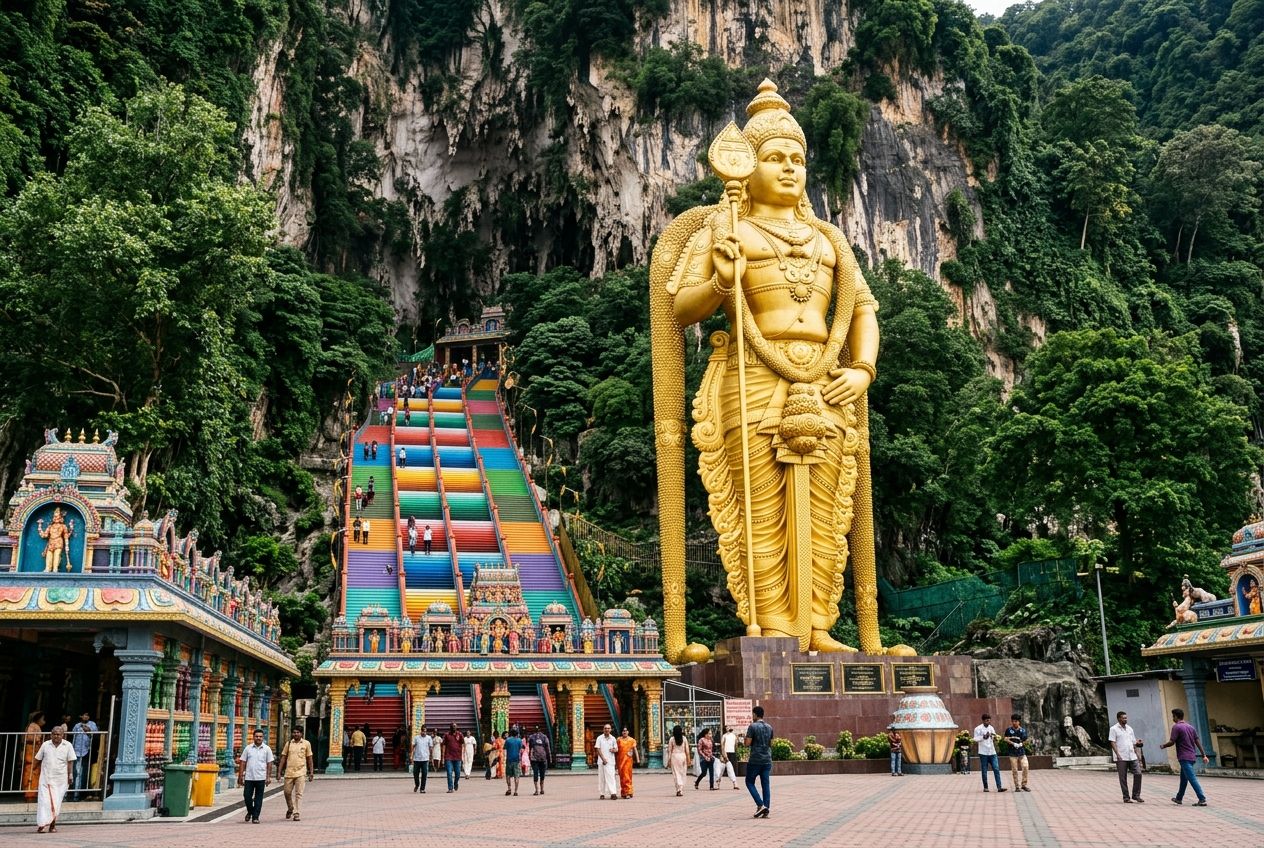
Day two belongs to Batu Caves and the surrounding region. The caves sit just 30 minutes from the city centre, and you’ll climb 272 rainbow-coloured steps to reach the 42.7-metre tall statue of Lord Murugan. Per details documented by Batu Caves visitor guides and Tripadvisor location records, the statue was unveiled in January 2006 after three years of construction. Here’s a tip that surprises many visitors: the main Temple Cave is free to enter, and only the adjacent Ramayana Cave charges a separate small fee.
The limestone cavern opens your eyes to Malaysia’s spiritual side. If you’re deciding between self-guiding and booking a tour, consider that travellers using guided combo schedules spend less time lost in transit and more time inside the caves and surrounding shrines.
The door-to-door pickup and timed entry can increase your effective sightseeing time significantly, making your two day itinerary feel less rushed. From there, head to Putrajaya for government architecture or push on to the Highlands if you want cooler air and tea plantations.
Our Batu Caves combo tour handles transport and timing so you skip the confusion. Two days gives you breathing room; you’re not sprinting between attractions or collapsing into your Pan Pacific bed exhausted.
You’ve tasted the city, touched its temples, and felt its rhythm without that frantic first-time-visitor energy.
Three Days in Kuala Lumpur
Three days in Kuala Lumpur gives you breathing room. You can explore without rushing from one sight to the next.
On your first day, wander through the historical heart where Malaysia declared independence in 1957 at Merdeka Square. The Sultan Abdul Samad Building and Royal Selangor Club stand nearby, their colonial architecture telling stories of the city’s past. Head to Central Market, which dates back to 1888 and now buzzes with traditional crafts, art stalls, and local food.
Chinatown’s narrow streets pull you deeper into KL’s character. Visit these three spots to see how different communities shaped this city:
- Sri Maha Mariamman Temple: the oldest Hindu temple in KL, with an ornate gateway tower.
- Guan Di Temple: a working Taoist temple thick with incense.
- Chan She Shu Yuen Clan Ancestral Hall: a beautifully restored Cantonese clan house.
Spend your evening at Bukit Bintang, where street food vendors, restaurants, and shops keep the energy alive until late.
Your second day takes you into nature and modern landmarks. The KL Forest Eco Park canopy walk lifts you above the rainforest, offering city skyline views that shift your perspective entirely. Afterwards, head to the Petronas Twin Towers, which stood as the world’s tallest buildings from 1998 to 2004. Watch the sunset from the observation deck; the towers glow against the darkening sky.
Day three opens up options. You could visit the National Museum of Malaysia to deepen your understanding of the country’s story, or venture out for a half-day trip to Putrajaya’s grand government architecture and manicured gardens.
Or, book an evening excursion to Kuala Selangor to witness fireflies dancing across the river at dusk. This pace lets you soak in each experience rather than simply ticking boxes on a list.
Four to Five Days with Day Trips
Four to five days in Kuala Lumpur gives you real breathing room. You can explore the city’s main attractions without rushing, then venture out on proper day trips. KL Sentral serves as your transport hub, connecting you to destinations across Peninsular Malaysia.
Historic Malacca sits just two hours away and rewards visitors with colonial architecture, street food, and the atmospheric Kwai Chai Hong shophouses. Taman Negara, the world’s oldest rainforest, lies about three hours from the city and offers canopy walks, river cruises, and wildlife spotting that simply cannot happen in an urban setting.
Your KL itinerary might include the Petronas Twin Towers, KL Tower for panoramic views, and the KL Forest Eco Park Canopy Walk. The Pan Pacific Serviced Suites Kuala Lumpur or ParkRoyal properties provide comfortable bases between your daily adventures. Staying near KL Sentral makes early departures straightforward.
Planning the Longer Trips
Longer day trips demand careful planning. Cameron Highlands, a mountain retreat famous for tea plantations, requires a three to three and a half hour drive each way, which consumes your entire day.
Melaka offers more value for your time investment, combining history with culinary experiences in a single outing. Consider mixing one substantial excursion, like a guided tour to Historic Malacca, with shorter city-based activities. The KLOOK Kuala Lumpur Pass saves money across multiple attractions if you’re visiting several sites independently.
A five-day split that works well from our experience:

- Two full days exploring central KL
- One day for Malacca
- One day for Taman Negara or another rainforest experience
- One flexible day for shopping at Pavilion KL or relaxing at the Pan Pacific Discovery lounge
This structure prevents exhaustion whilst maximising your Southeast Asia exposure. Our day trips article outlines specific options with transport times and what each location genuinely offers.
A Week or More in Peninsular Malaysia
A week gives you real breathing room to explore beyond Kuala Lumpur’s city limits. You can use KL as your base and take day trips to the Batu Caves or the Petronas Twin Towers, or you can hop on trains and buses to neighbouring regions.
The 12 GO ASIA platform makes booking trains to Singapore and Thailand straightforward, whilst buses from Terminal Bersepadu Selatan offer comfortable budget options to Penang, Langkawi, and the east coast islands. Each destination feels distinct, so you’ll taste different flavours of Malaysia rather than just one city’s rhythm.
Penang pulls visitors with its street food scene and colonial architecture, whilst Langkawi delivers island relaxation and duty-free shopping. The east coast islands offer pristine beaches and diving, though you’ll want to avoid November through February when monsoon season closes many spots.
Pack light, move slowly between places, and let the journey itself become part of your story. You’ve earned the luxury of time, so use it to wander, chat with locals, and stumble upon the moments that don’t make it into guidebooks.
If You Only Have a Long Layover
Your layover window matters more than you might think. Six hours gives you breathing room, though eight or more hours opens up a proper circuit of the city.
KLIA sits roughly 50 to 60 kilometres south of Kuala Lumpur, so factor in travel time both ways. The KLIA Ekspres train whisk you to KL Sentral in about 30 minutes, and per current fares listed on the official KLIA Ekspres website, a one-way ticket costs RM55 (RM100 return), with trains departing every 15 to 20 minutes. Booking online in advance saves about 10%. You can also book an airport transfer service in advance for a smoother journey.
Either option beats the stress of rushing through security again without exploring anything worthwhile.
The Real Time Budget
The published journey time looks tidy on paper, but the reality includes more steps than most travellers expect. Here’s how a typical layover run breaks down:

- Around 40 minutes for passport control and collecting baggage if required
- Another 10 minutes buying your KLIA Ekspres ticket and waiting for the next departure
- The 28-minute train ride to KL Sentral, then a 15-minute Grab ride into Chinatown
- Roughly 90 minutes in Chinatown for food and market browsing, plus a 35-minute return buffer
The total round trip approaches four hours when you include queues and transfers. That makes a six hour layover tight but an eight hour layover workable.
Focus your layover on what matters most: food and walkable neighbourhoods. Chinatown and Bukit Bintang reward short visits because you can cover genuine ground on foot without needing transport logistics.
Grab street food, sip coffee at a local café, wander through markets. Our KLIA transit tour handles the logistics if you’d rather have a guide show you the highlights and get you back on time.
Grab a MyRapid Card if you’re hopping between spots using public transport; it costs little and removes the hassle of buying individual tickets. The city’s comprehensive, affordable transport system makes layovers genuinely doable, not just something you endure in an airport lounge.
How Long Each Attraction Actually Takes
Here’s what our guides encounter on the ground, every single week, so you can plan without guesswork.

| Attraction | Time Needed | Worth It For |
|---|---|---|
| Petronas Twin Towers | 2 to 3 hours | The skyline views. Book online in advance; tickets sell out regularly. |
| Batu Caves | 1.5 to 2 hours | First-timers wanting the iconic photo. Half-day trips work well here. |
| KL Tower (Menara KL) | 1.5 to 2 hours | Panoramic views from the observation deck, or dinner at the revolving restaurant. |
| Merdeka Square | 45 minutes to 1 hour | History buffs and photography. Walk the perimeter; skip if pressed for time. |
| Chinatown (Petaling Street) | 1.5 to 2 hours | Street food, souvenirs, and local colour. Go early to avoid crowds. |
| Central Market | 1 to 2 hours | Colourful stalls, local crafts, and the buzz of city life. |
| KLCC Park | 1 to 1.5 hours | A quick break from the city. Families appreciate the open space. |
| Islamic Arts Museum Malaysia | 2 to 3 hours | Art lovers and those wanting lunch at Moza Restaurant and Cafe onsite. |
| Kuala Lumpur Bird Park | 2 to 3 hours | Morning or afternoon visits suit best. The world’s largest free-flight aviary. |
Most visitors pack too much into one day and end up rushing. These figures come from what we actually see in operation, week after week.
Petronas Towers demand advance online booking because limited space fills fast. Our guided runs consistently show the towers need roughly two to two and a half hours for a comfortable visit, assuming you booked tickets ahead and factored in a short mall break. Average on-site time, including the queue, skybridge, and observation deck, runs about 2 hours 15 minutes, with most visits falling between 1 hour 45 minutes and 2 hours 45 minutes.
A few more notes from the ground:
- Batu Caves work brilliantly as a half-day excursion. Many people underestimate the climb, but the photo reward justifies it.
- KL Tower’s observation deck beats the Towers for convenience, though views from the Towers feel more dramatic.
- Merdeka Square works best as a quick stop between other sites, and Chinatown rewards those who arrive before 10 am.
- Central Market keeps visitors engaged for an hour or two, while KLCC Park serves as a palate cleanser, nothing more.
- Islamic Arts Museum deserves the full three hours if art matters to you; the onsite Moza Restaurant and Cafe make it easy to stay longer.
- Bird Park’s free-flight concept means slower movement than a traditional zoo, so plan accordingly.
What to Skip if You Are Short on Time
You face tough choices on a short Kuala Lumpur itinerary, so cut the activities that drain hours without delivering memories. Focus your energy on the iconic sites that actually make the trip worthwhile.
Crowds are growing too. According to Malaysian tourism arrival data reported via Malay Mail in 2025, international arrivals to Kuala Lumpur jumped 62.1% to 10.1 million visitors in 2025, up from 6.2 million in 2024. That makes queues at flagship sites like the Petronas Towers and Batu Caves more likely during peak periods, so prioritising well and booking ahead matters more than ever.
- Shopping malls take up entire afternoons and offer little that you cannot find at home; spend those hours at the Petronas Twin Towers or exploring street art at Kwai Chai Hong instead.
- The restored shophouses look charming in photos, but they consume time without the payoff of other cultural sites; skip them if your 2 days in Kuala Lumpur are already packed.
- Urban areas outside the city centre feel repetitive and generic; your 3 days in Kuala Lumpur work better when you stick to established attractions rather than wandering aimlessly.
- Day trips to both Melaka and Penang are not feasible on a short itinerary; pick one or stay in the city and use those hours for proper exploration of what Kuala Lumpur actually offers.
- Suburban neighbourhoods lack the draw of central landmarks; invest your time in Merdeka Square, the National Mosque, or Batu Caves instead, where you gain real cultural insight.
- Nature activities remain limited compared to other Malaysian destinations, so resist the urge to chase outdoor adventures here; save those for Penang or further afield in south east asia.
Conclusion
Two or three days gives the city justice without wearing out your feet. Add a day trip to Batu Caves or Putrajaya, and the time clicks into place.
That’s when Kuala Lumpur stops feeling like a checklist and starts feeling like home.
Our guides run these routes weekly, and we’ve seen it work best when visitors stay long enough to breathe, not just snap photos. The facebook community and Pacific Lounge regulars will tell you the same thing: how long to stay in kuala lumpur matters less than staying long enough to skip the rush.
FAQs
1. How long to stay in Kuala Lumpur?
Three days works well for most first-time visitors, covering the Petronas Towers, street food, and a temple or two. Batu Caves sits just 13 kilometres north if you extend to four days, or add Melaka for a fifth.
2. Is one day enough for Kuala Lumpur?
One day is a quick dash but doable if you stay in the Golden Triangle, where most major sights cluster together within a short walk or Grab ride.
3. How do I plan my trip and find travel tips?
Facebook groups focused on Malaysia travel are packed with honest advice from recent visitors, and you’ll typically get useful answers about timing and planning within a few hours of asking.
4. What is the Pacific Lounge, and is it worth visiting?
The Pacific Lounge sits in the Pacific Regency Hotel Suites on Jalan Puncak, with views over the city skyline and a quiet setting for a drink after sightseeing.